

I've spent most of my life trying to understand how consciousness works - first through bodybuilding and code, then through psychology, music, and AI. Human Math is what fell out when I finally wrote it all down.
Now I make things - books, songs, essays, tools - that help people see themselves more clearly and live lives that feel like they actually belong to them.
I started lifting at 12 because I realized you could literally rewrite your body if you understood the system. That became the template for everything: find the system, understand it deeply, then reshape it with intention.
Software engineering, music production, consulting - each domain was another angle on the same question: how do humans work, and why do some of us feel so out of sync with ourselves?
Along the way, I kept having conversations about cognitive functions and personality structure that quietly blew people's lives open. Five conversations, five 'oh... everything makes sense now' moments. That's when it clicked: self-awareness isn't a luxury or a vibe. It's infrastructure.
I looked for the book that held multiple personality models simultaneously while treating cognition as lived texture rather than behavioral checklist - without wrapping the whole thing in spiritual language. It didn't exist.
So I wrote it. Human Math is fifteen years of pulling apart how humans work, compressed into five dials and one framework.
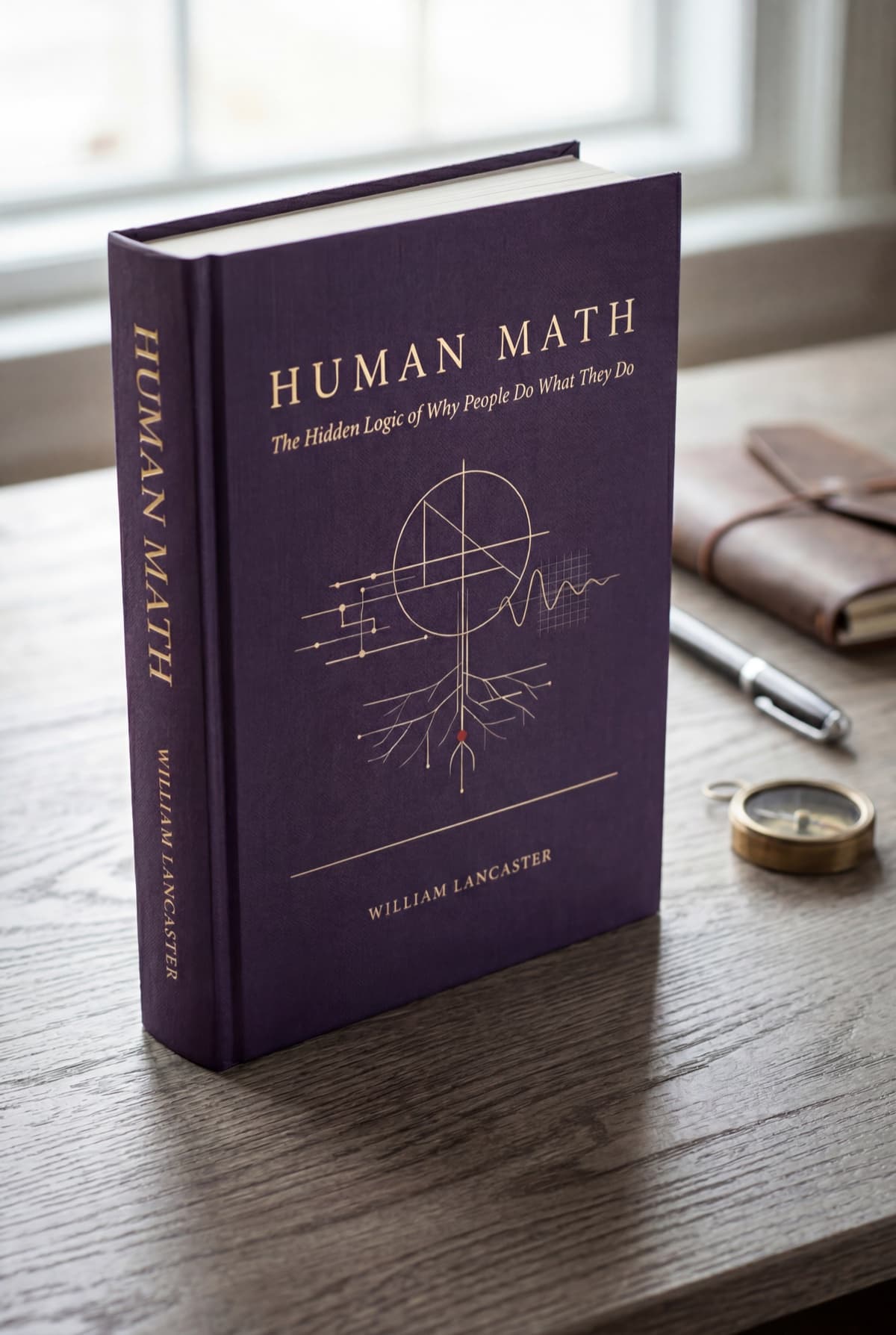
Human Math is the foundation. Everything else I build is an expression of the same underlying framework - different formats for different parts of the human experience.
As an INTP 3w4 sp/sx, this is the only game that ever really made sense to me: understand cognition deeply, build elegantly, and try not to lose the plot on being human in the process.
If I do this right, there will be people I never meet who think better, feel safer, and suffer less because I existed. That's the metric that matters.
We didn't evolve 16+ personality types by accident. No single nervous system can hold every dimension of wisdom - the trade-offs are too severe. Every type sees something the others miss.
In that sense, we're not isolated individuals. We're nodes in a large, slightly dysfunctional, but beautiful distributed intelligence system called humanity.
The problem is most nodes are running with corrupted self-models. They're chasing someone else's version of success, numbing out on someone else's values, and wondering why everything feels subtly wrong.
As AI automates more of what we do, what remains is who we are: our perspective, our sensitivity, our way of making meaning. That's the part you can't outsource.
But you can't contribute your perspective if you've never been given language for it. You can't live as yourself if you don't know your own contours.
That's why Human Math exists. And that's why everything I build - whether it shows up as a book, a song, an essay, or an AI tool - is aimed at the same thing: helping people become accurately, courageously themselves.